
By Jaysen Mansfield, Artbound Ink & Form

Some materials whisper. This one walks in wearing armor.
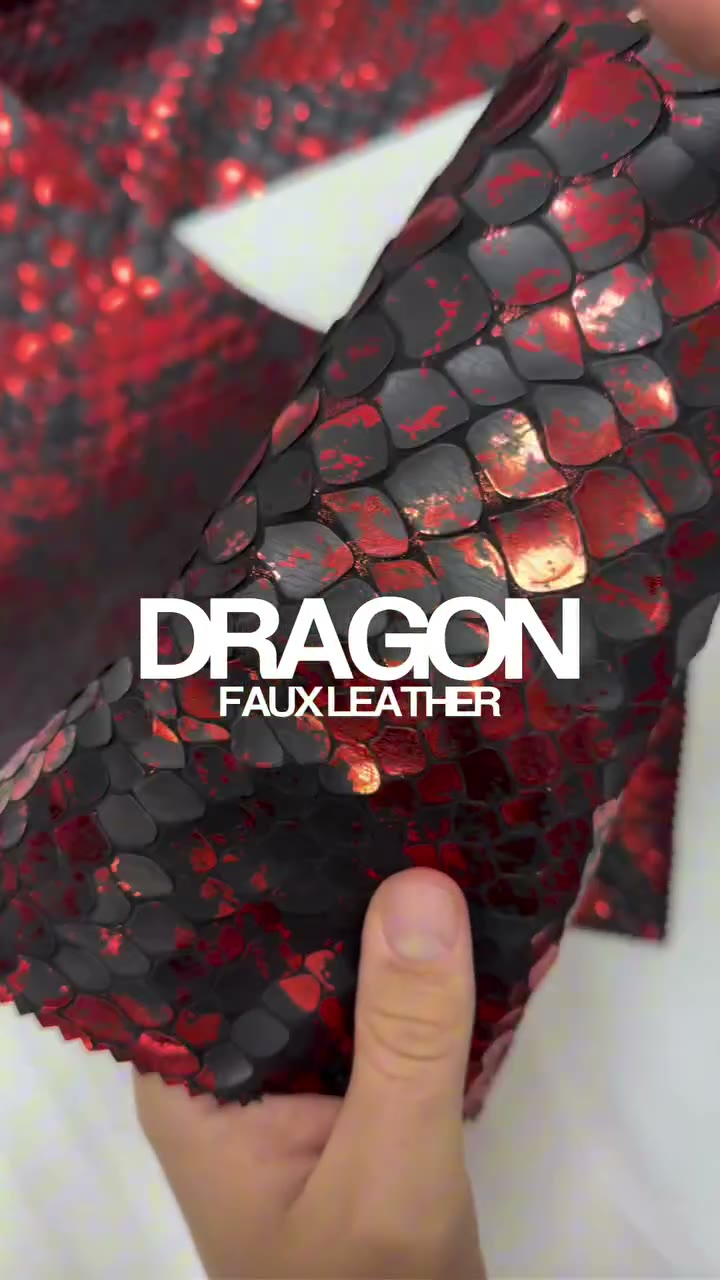
In a short reel posted this week, the textile studio Fabric Future holds a sheet of its dragon faux leather up to the camera and does the simplest, smartest thing a material can do: it bends it. The sheet folds in the hands like cloth — but its surface is a field of overlapping scales, glossy and raised, and as it moves, the color travels with the light: deep red into orange into black, like embers shifting under a surface. It looks like something a creature would wear. It moves like something a person could.
That tension — armor on the surface, fabric in the hand — is exactly why I stopped scrolling.
What the maker says
Fabric Future describes the material in its own words, and the description is worth quoting properly:
“High-quality faux leather featuring a textured face with slightly raised scales. Its distinctive appearance resembles reptile skin. The reverse side is smooth, soft, and pleasant to the touch. The material is breathable, allowing air to pass through.”
— Fabric Future, “DRAGON FAUX LEATHER” reel caption, October 15, 2026

Two of those details matter more than they might seem. The smooth reverse side is the difference between a costume you endure and a garment you live in — the face performs, the back has to be kind. And “breathable” is a claim most faux leathers can’t make; if it holds up in wear, it changes where this material can go, from a stage piece to something carried all day.
The specifications, exactly as published
- Face: 100% PU
- Backing: 100% polyester
- Thickness: 0.4mm
- Width: 1.40m
A plain-language note for readers: PU is polyurethane, so this is a faux leather — no animal hide — built on a polyester backing. At 0.4mm it is thin and flexible, closer to a garment material than an upholstery hide, which matches what the reel shows: the sheet drapes and folds rather than standing stiff.
Seven colorways
Fabric Future lists the palette as:
- White/Gold
- White/Silver
- White
- Black/Gold
- Black/Silver
- Black/Red
- Black/Green
The reel demonstrates the Black/Red — the ember one. But look at the shape of the palette: three lights, four darks, and every dark paired with a metal or a jewel tone. In my own work I treat color as part of a composition’s emotional register — what a color does inside a piece, next to everything around it. Gold laid over black scales reads as treasure and ceremony; green over black reads as something older and wilder. Same scales, completely different creature. That is good palette design: the material stays itself while the story changes.
Why a scale surface hits so hard
A scale is one of the oldest visual signals there is. In composition, scales and dragon imagery carry associations of protection, power, and transformation — the creature that grows its own armor, sheds, and comes back changed. Worn on a body, a scaled surface borrows all of that at once: it says the wearer is guarded and dangerous and mid-transformation, before a single word is spoken.

That is the heart of wearable identity design as I practice it: the surface is not decoration, it is the first sentence. Most fabrics can only speak through color and drape. A textured surface like this one speaks through light itself — every movement re-lights the scales, so the garment keeps changing its mind about what color it is. Static clothing holds still for the camera. This wouldn’t.
An honest note on what I know and don’t
I have not handled this material. Everything above rests on Fabric Future’s reel and its published specifications, both linked below, and on what the footage plainly shows: the scale texture, the color travel, the way the sheet folds. The breathability and the hand-feel of the reverse side are the maker’s claims, quoted as claims. If I get a length of it in the studio, I’ll write the follow-up with my hands instead of my eyes.
Where a material like this belongs

Statement pieces that carry their own lighting. Accessories — bags, cuffs, collars, book covers — where a small field of scales does the work of a whole print. Cosplay and performance work, obviously, where the armor illusion is the point. And surface design generally: any place a flat print is currently pretending to be a texture, this is the real thing standing next to it.
Materials like this are why I keep saying the future of wearable art is not flatter and faster. It’s more tactile, more symbolic, more alive in the hand. A sheet of scales you can sew is a small, glossy proof.
Source and credits: Reel and product by Fabric Future (@fabricfuture), a textile studio whose bio describes “a unique selection of rare fabrics.” Watch the original reel: https://www.instagram.com/reel/Dei5LIkh6Ni/ — All quoted wording and specifications are Fabric Future’s, from that post (October 15, 2026). Stills in this article are frames from that reel, used with credit to Fabric Future.
Jaysen Mansfield is a visual artist, author, and designer behind Artbound Ink & Form, a creative studio exploring color, light, symbolism, and identity.
Leave a Reply
You must be logged in to post a comment.